

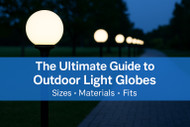
The Ultimate Guide to Outdoor Light Globes (Sizes, Materials, Fits)
Outdoor post-tops and wall fixtures depend on plastic (acrylic or polycarbonate) globes to protect the lamp and shape the beam. When it’s time for a replacement light globe, getting size, material, and neck type right is everything—otherwise you’ll fight rattles, leaks, and glare.
1) How to measure a globe (the accurate “floor + wall” method)
Pro Tip: Don’t hook a tape inside the neck opening. On neckless globes that reads small—the hole size makes the diameter look off.
Steps (2 minutes):
-
Place a soft cloth against a wall. Set the globe on the floor with its opening facing sideways.
-
Gently slide the globe until it just touches the wall.
-
Hold a flat board or hardcover book upright against the opposite side of the globe so it barely touches.
-
Measure from the wall to the inside face of the board at mid-height. That distance is the true outside diameter (e.g., 18", 20", 22").
Now confirm the connection:
-
Neckless (open-bottom): Measure the inside diameter of the globe opening and the outside diameter of your fixture ring/band. Check for gasket and set screws.
-
Fitter neck (e.g., 3" fitter): Measure the outside diameter of the globe neck and the inside diameter of the fitter. Ensure screws/retaining ring match.
-
Threaded neck: Measure across the threads (OD). No calipers? Wrap paper around, mark, measure the paper length (circumference), then OD = circumference ÷ 3.1416.
2) Materials: Acrylic vs. Polycarbonate
Acrylic (PMMA)
-
Superior clarity and gloss; strong UV stability (great long-term appearance)
-
Rigid; can crack if hit hard
Best for: neighborhoods/HOAs, campuses, general commercial sites where looks and UV performance matter.
Polycarbonate (PC)
-
Impact-resistant (vandal/hail/wind-borne debris)
-
More scratch-prone; clean gently; UV-stabilized versions recommended outdoors
Best for: vandal-prone or high-traffic areas, parks, transit, coastal/windy sites.
Finishes (diffusion):
-
Opal/white: hides the lamp, soft even glow (most popular)
-
Prismatic: cuts glare and evens distribution
-
Clear: maximum output/visibility (watch for glare)
3) Sizes & typical applications
| Globe Ø | Common Uses | Lamp Ideas (guidance) |
|---|---|---|
| 8"–12" | Path lights, porches, small posts | 3–7W A19 LED (2700–3000K warm; 4000K crisp) |
| 14"–16" | Walkways, small parking islands | A19/A21 LED; prismatic to reduce glare |
| 18"–20" | Streetscapes, courtyards | A21 or compact “corn” LED; opal for uniformity |
| 22"–24" | Parks/HOAs, campus | Higher-lumen A21/corn LED; opal/prismatic |
| 27"–36" | Boulevards, plazas, tall posts | High-output LED; often neckless mounts |
Always check socket type, max wattage, and internal space for heat/airflow.
4) Neckless vs. Fitter vs. Threaded: which fit is right?
-
Neckless (open-bottom)
-
Common on larger diameters (18"–36").
-
Sits on a ring/band with set screws and gasket.
-
Clean, uninterrupted look; easy service.
-
-
Fitter neck (most often a 3" fitter)
-
Most common post-top connection.
-
Neck slides into the fitter; secured by screws/ring.
-
Measure both neck OD and fitter ID.
-
-
Threaded neck
-
Globe screws onto a threaded collar; fast maintenance.
-
Match thread OD/style to your collar.
-
5) Choose in 3 steps
-
Match the neck type (neckless / 3"/4"/6"/8" fitter etc / threaded).
-
Pick material (acrylic for UV clarity; polycarbonate for impact).
-
Select size & diffusion (opal/prismatic to tame glare near pedestrians).
Nice add-ons: fresh gasket, correct retaining ring/band, and an outdoor-rated LED at the right lumens/CCT.
6) Installation & care tips
-
Seat the globe on a good gasket; snug set screws just past hand-tight—don’t crack the neck.
-
For neckless, confirm the ring OD fits the globe opening ID before tightening.
-
Clean with mild soap + water and microfiber; avoid harsh solvents/abrasives.
-
In coastal sun/wind, prefer UV-stable materials and stainless hardware.
-
If you see condensation, add/clear a tiny weep path per fixture design.
Shop the way pros do
-
By Size: All Outdoor Light Globes (6"–36")
-
By Material: Acrylic | Polycarbonate
-
By Color: White | Smoke | Clear | Frost | Amber etc
Outdoor Light Globes — Frequently Asked Questions
Sizing, materials, fits, glare control, and retrofit tips.
How do I measure a globe accurately?
What’s the difference between pole/tenon size and globe fitter size?
Which material lasts better outside: acrylic or polycarbonate?
How do I identify my neck type (neckless vs. fitter vs. threaded)?
What size globe should I buy?
How do I stop sidewalk glare?
My globe rattles or squeaks in wind—how do I fix it?
There’s condensation/water inside—what should I do?
Can I switch to LED in older post-top fixtures?
How should I clean and maintain plastic globes?